
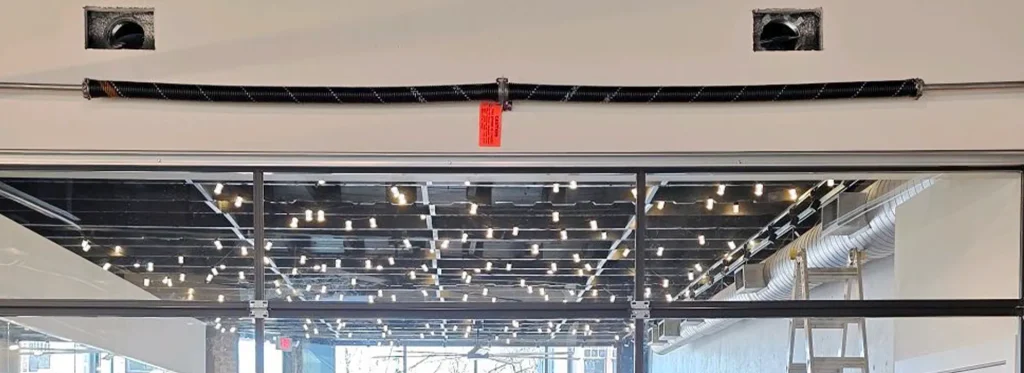
The signs that garage door springs need replacing are often present weeks or months before spring breaks, but most homeowners miss them because the door keeps working. One of the more instructive calls in this regard is a homeowner who described a slow door, still opening and closing, just noticeably slower than before. On inspection, the torsion spring had lost significant tension after years of daily cycling. The spring was within weeks of snapping, the opener motor showed early gear wear from compensating for the added load, and the cable on one side had begun fraying under the stress. What the homeowner saw as a minor inconvenience was the spring system communicating a clear replacement signal. For homeowners in Marshall and surrounding areas, knowing how to read those signals separates a planned replacement from an emergency call.
Why the Door Still Working Does Not Mean the Springs Are Fine
The most common reason homeowners miss spring replacement signals is straightforward. As long as the door opens and closes, most people assume the system is fine.
A garage door spring loses tension gradually over thousands of cycles. A torsion spring rated for 10,000 cycles that has run 8,000 to 9,000 cycles carries significantly less counterbalance force than it did when new. That tension loss does not stop the door from moving. It shifts the load onto the opener motor and cables, which absorb the work the spring can no longer do. The door keeps operating while the system degrades quietly.
ANSI/DASMA 103, the standard governing counterbalance systems on residential sectional garage doors, specifies that spring sizing must match door weight precisely because the consequences of operating below designed tension compound across every connected component with every cycle.
What we consistently find on calls placed for a struggling opener or a slow door is a spring at or near the end of its rated cycle life. The opener showed the symptoms. The spring was the source. A door that keeps moving is not confirmation the spring is healthy. It is often confirmation the opener is absorbing the load the spring can no longer carry.
The Door Feels Heavier Than It Used To
One of the earliest and most reliable signals that springs need replacing is a door that feels physically heavier when lifted manually.
As a torsion spring loses tension over its rated cycle life, it contributes progressively less counterbalance force to the door weight. That loss happens so gradually that daily use masks it until the gap between what the spring provides and what the door needs becomes impossible to ignore.
The balance test is the most reliable homeowner-accessible diagnostic. Disconnect the opener using the manual release cord and lift the door to mid-height. A properly tensioned spring should hold the door in place. A door that drops indicates the spring is under-tensioned and past its effective service life. A drop of more than one to two inches warrants a professional evaluation.
In our experience, homeowners who perform the balance test for the first time are often surprised by how much the door drops. Because the decline in spring tension happens over hundreds of cycles, the shift is invisible in daily use. The balance test makes that cumulative loss visible in a single moment.
That result is not a reason to panic. It is the information needed to schedule a spring replacement before complete failure rather than after.
The Opener Is Working Harder Than It Used To
A spring losing tension shifts progressively more door weight onto the opener motor with every lift cycle. The motor runs louder, the door moves more slowly, and the opener may strain or hesitate before completing the cycle.
This symptom is consistently misattributed to an aging opener, leading to opener replacement when the spring is the actual problem. What we find on these calls is that the opener is in reasonable condition. The spring is the source, and the opener has been compensating for months, accelerating its own wear in the process.
IDA-certified technicians assess the full door system before any opener repair is recommended. That assessment is what catches spring tension loss as the root cause rather than treating the opener strain as an isolated problem. A replaced opener paired with a spring at the end of its cycle life will show the same symptoms within months, because the underlying cause was never addressed.
Catching the spring replacement needed through opener strain signals is always a better outcome than replacing the opener first and discovering the spring was the source all along.
The Door Moves Unevenly or One Side Feels Off
A door that rises faster on one side than the other, tilts during operation, or racks in the tracks is showing a spring tension imbalance across the two sides.
Both springs wear at roughly the same rate because they were installed at the same time and cycle the same number of times. But slight differences in coil condition, East Texas humidity exposure, and load distribution can cause one spring to lose tension faster. That imbalance shows up as uneven door movement.
An imbalanced door puts uneven stress on the cables, drums, rollers, and tracks on every cycle. The side carrying more load wears faster. Cables fray sooner on the heavier side. Rollers develop more lateral friction on the lower-tension side.
What we find on calls where a tension imbalance has gone unaddressed is that cable wear on the heavier side has progressed significantly faster than on the balanced side. A repair that would have involved spring replacement alone has grown into a spring, cable, and drum repair because the imbalance ran too long.
What You Can See on the Spring Itself
Several spring replacement signals are visible from the floor without touching any hardware, which is where a homeowner should stay.
A visible gap of one inch or more in the torsion spring coil is a confirmed break. The spring has separated under tension and the door should not be used until replacement is complete. A spring approaching failure may also show stretched or uneven coil spacing before a full break, visible from a safe distance.
Surface rust or corrosion on the coils is another indicator. DASMA’s technical guidance on spring cycle life specifically identifies corrosive environments as a factor that shortens spring lifespan by weakening wire strands between cycles. In Marshall, where summer heat and humidity are consistent seasonal factors, visible rust on a spring coil represents real structural degradation rather than cosmetic discoloration.
Cable condition alongside the spring is a reliable secondary confirmation. Because cables and springs wear at the same rate, visible fraying along the cable strand almost always accompanies a spring at or near the end of its cycle life. When both signs are present together, replacement on the same visit is the right call.
When Observation Is Not Enough and a Professional Assessment Is Needed
The balance test, visual coil inspection, and opener strain observation are all homeowner-accessible diagnostics that provide useful replacement signals. But confirming the actual tension remaining in a spring, assessing drum position on the torsion bar, and evaluating cable condition along the full strand length require proper training and specialized tools.
The 25-point safety inspection our technicians complete on every service call is specifically designed to assess what homeowners cannot evaluate accurately on their own. Spring tension is measured against the actual door weight. Coil condition is evaluated up close for corrosion, fatigue, and spacing irregularities. Door balance is tested to the correct threshold. The full cable system is inspected for fraying that often accompanies a spring nearing the end of its rated life.
IDA-certified technicians are trained to interpret these findings honestly and give homeowners an accurate picture of where the spring system stands. The assessment is not about finding reasons to recommend replacement. It is about giving homeowners the information needed to make a confident decision about timing.
A spring assessed as needing replacement now gets replaced now. One approaching end of life but not yet critical gets flagged so the homeowner can plan on their own timeline rather than reacting to a sudden failure. That transparency is part of how the 25-point inspection works.
Schedule Garage Door Spring Replacement With Lonecrest Garage Doors
Catching spring replacement signals before a failure is always a better outcome than reacting after the spring snaps. A spring replaced on schedule protects the opener, the cables, and the full system from the compounding wear a failing spring creates past its rated service life.
At Lonecrest Garage Doors, every service visit includes a 25-point safety inspection that evaluates spring tension, coil condition, and door balance and gives homeowners an honest picture of where their system stands. Homeowners who choose a full rebuild are covered by the 10-year rebuild warranty on springs, cables, rollers, drums, and bearings.
Lonecrest Garage Doors serves homeowners in Marshall and nearby areas with veteran-owned, IDA-certified service built on honest assessments and dependable workmanship. Reach out to Lonecrest Garage Doors today to schedule a spring inspection and find out where your system stands before the spring makes that decision for you.