
When a garage door cable breaks, the door loses its counterbalance on one side and becomes unsafe to operate immediately. One of the more instructive calls in this regard is a homeowner who heard a loud snap and found the door hanging at an angle, the right side sitting significantly lower than the left. The cable had snapped, the bottom bracket had pulled away from the door panel, and the drum had slipped out of its set position on the torsion bar. What looked like a single cable failure cascaded into a three-component repair. For homeowners in Marshall and surrounding areas, understanding what a cable break sets in motion is the difference between a repair handled correctly and one that grows more complicated with every attempt to use the door.
How Garage Door Cables Work and Why They Matter
Residential garage door cables are made from stranded galvanized steel wire, typically in a 7×19 configuration: seven groups of 19 individual wires twisted together. That construction gives each cable the flexibility to wind around a drum and the tensile strength to handle a door weighing anywhere from 150 to 400 pounds.
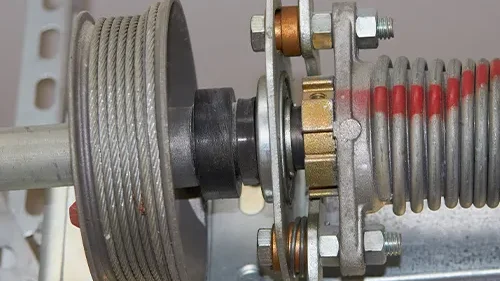
The cables run from the bottom bracket at the base of the door up along the sides and wind around drums on the torsion bar above. When the torsion spring releases tension during opening, the drums rotate and wind the cables upward, lifting the door on both sides evenly.
Cables do not lift the door on their own. They transfer the spring’s stored energy into movement. That distinction matters because it explains why a cable break is almost always a symptom of a system under stress. ANSI/DASMA 103, the standard governing counterbalance systems on residential sectional garage doors, treats the cable and drum assembly as integral components of the counterbalance mechanism.
What Actually Happens the Moment a Cable Breaks
The moment the cable snaps, the affected side of the door loses its support and drops instantly. The drum on the broken side may spin freely without the cable to anchor it, slipping out of position on the torsion bar. Once the drum slips, the geometry of the cable path on the working side changes, putting additional stress on the remaining cable.
The bottom bracket anchors the cable to the bottom corner of the door panel under significant tension at all times. A sudden cable break transfers that load to the bracket instantly. Depending on the force and the bracket’s condition, it may bend, crack, or pull away from the panel. Bottom brackets connect directly to the spring and cable system and sit under enough tension that replacing or adjusting them is a professional-only task.
In some cases the door comes partially off its tracks as the rollers lose alignment under the one-sided drop. What arrived as a cable repair call becomes a cable, drum, bottom bracket, and track repair before the door can safely move.
In our experience, calls involving the most additional damage are consistently the ones where the homeowner kept operating the door after the cable had already broken, often not realizing the cable was the cause of the change in how the door moved.
Why Cables Break: The Most Common Causes
Cable failures are rarely random. In most cases the break is the end point of a wear process developing over months or years.
Daily cycle fatigue is the most common cause. Over thousands of cycles, individual wires within the strand develop small breaks under the repeated bending stress of winding around the drum. The accumulated loss of tensile strength eventually reaches a point where the cable can no longer hold the load.
Marshall’s humidity and heat allow moisture into the individual wire strands and begin oxidizing the steel. DASMA’s technical guidance on cable and spring system performance specifically identifies corrosive environments and extreme heat as factors that shorten cable lifespan by weakening wire strands faster than mechanical fatigue alone, both conditions that East Texas homeowners deal with through much of the year.
A weakened or broken spring is another major cause. When a spring loses tension, the cable on that side absorbs more door load than it was designed to carry. What we find consistently on cable repair calls is that the spring system needs attention as well. Cables and springs wear at roughly the same rate, and a broken cable almost always signals a spring approaching the end of its service life.
Improper installation creates abnormal stress from day one. A cable wound incorrectly on the drum or paired with a mismatched spring produces failure patterns identifiable during a full system inspection.
Why You Should Stop Using the Door Immediately
Without cable support on one side, the door is no longer counterbalanced and the opener cannot safely lift it. Forcing the motor strains it against a load it was never designed to handle, accelerating gear wear and risking burnout. The remaining cable carries more than double its intended load, putting it at immediate risk of failure as well.
The tracks also sustain damage when the door operates without proper cable support. Rollers bear the imbalanced load against the track walls rather than distributing it evenly, bending the tracks and pulling rollers out of alignment.
We have arrived on calls where the track damage from continued operation after a cable break had added significantly to the repair scope. A call placed shortly after the break with the door closed is a straightforward cable replacement. A call placed after several attempts to force the door up is a different job. The safest response is to leave the door where it is and call for professional garage door cable repair.
What a Professional Cable Repair Actually Involves
A cable repair goes beyond replacing the cable. The condition of every component the cable connects to needs to be evaluated before the replacement goes in.
The technician first safely releases any remaining spring tension before cable work begins. Once released, the broken cable is removed and the drum is inspected for slippage on the torsion bar. The bottom bracket is checked for bending or separation from the panel.
The replacement cable is installed to the correct specification, wound onto the drum at the proper tension, and anchored at the bottom bracket. The door is then disconnected from the opener and tested for balance by confirming it holds position at mid-height. A door that holds confirms the cable tension is correctly matched to the spring and door weight.
At Lonecrest Garage Doors, every cable repair includes a full inspection of the spring system. Because cables and springs wear at the same rate, a broken cable often signals a spring approaching the end of its rated life. Addressing both on the same visit protects the homeowner from a second call. Homeowners who choose a full rebuild are covered by the 10-year rebuild warranty on cables, rollers, drums, bearings, and springs.
Warning Signs a Cable Is Failing Before It Breaks
Most cable failures give observable warning signs before a full break, and catching them during a routine inspection is always a better outcome than a sudden failure.
Visible fraying along the cable strand is the most reliable early indicator. As individual wire breaks accumulate they appear as small bristles or separated wires along the cable surface. A cable showing those signs has lost a measurable portion of its tensile strength and should be replaced before reaching the point of failure under load.
Rust or discoloration along the cable is another sign, particularly in homes that see East Texas humidity levels. A door hanging slightly lower on one side can indicate a cable partially unwound from the drum. A scraping or popping from the lower corner of the door during operation can signal the cable or bottom bracket is under abnormal stress.
The 25-point safety inspection our technicians complete on every service call evaluates cable condition, drum alignment, and bottom bracket integrity. Cables flagged for fraying or early corrosion are almost always accompanied by a spring system also showing wear at varying stages. Catching both on the same visit is what prevents the cascade failure that turns a manageable cable replacement into a multi-component job involving drums, brackets, and track realignment.
Schedule Garage Door Cable Repair With Lonecrest Garage Doors
A broken cable is not a repair to delay or attempt without proper training and tools. The tension involved in the cable, drum, and spring system makes this a professional-only job at every step.
At Lonecrest Garage Doors, every cable repair begins with a full system inspection so the actual scope is understood before any work starts. That approach protects homeowners from a repair that addresses the cable and leaves the spring and drum to cause the next failure. Lonecrest Garage Doors serves homeowners in Marshall and nearby areas with veteran-owned, IDA-certified service built on honest inspections and dependable workmanship. Reach out to Lonecrest Garage Doors today to schedule your cable repair backed by the 10-year rebuild warranty.