
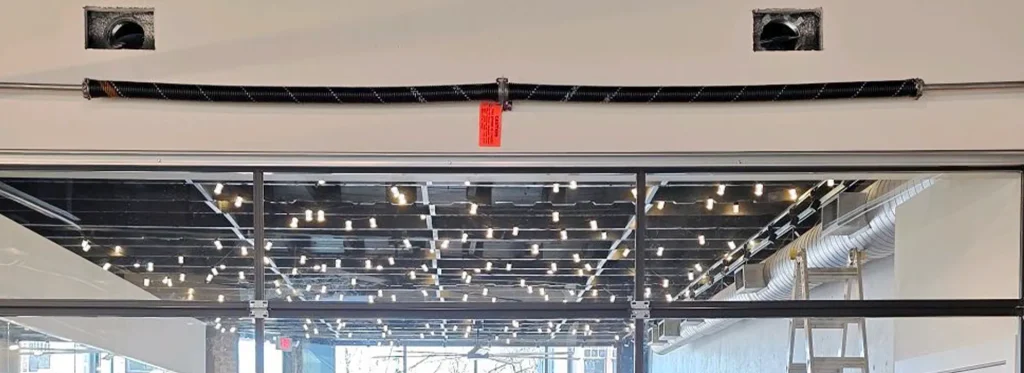
Most residential garage door springs are rated for approximately 10,000 cycles, which translates to somewhere between 4 and 14 years depending on how often the door is used. That range exists because spring lifespan is driven by cycle count, not calendar time. One of the more instructive calls in this regard is a homeowner who reported a sluggish door and assumed the opener was failing. The inspection told a different story. The spring had been quietly losing tension for months while the opener compensated by running harder on every lift cycle. The spring was within weeks of snapping, and the opener motor was already showing early gear wear from the sustained overload. For homeowners in Marshall and surrounding areas, understanding how spring lifespan is calculated is the most practical way to plan ahead rather than react after a failure.
What a Spring Cycle Actually Means and Why It Matters
Most homeowners are surprised to learn that garage door springs come with a measurable rated lifespan expressed in cycles rather than years. One cycle equals one complete open and one complete close of the door.
Standard residential torsion springs are rated for approximately 10,000 cycles, determined by manufacturers under controlled conditions. That rating represents the point at which the spring steel begins to lose structural integrity under repeated stress loading. It is not a guarantee of exact failure timing, but it is the engineering threshold the spring is built to reach.
High-cycle springs are available at 20,000, 30,000, and 50,000 cycle ratings, using thicker wire diameter and higher-grade steel. For homes with heavy daily use, the math on extended replacement intervals often justifies the investment.
ANSI/DASMA 103, the standard governing counterbalance systems on residential sectional garage doors, addresses spring specifications and performance requirements because the relationship between spring rating, door weight, and cycle life has real safety implications.
How Daily Use Determines When Springs Need Replacing
Once the cycle concept is understood, the replacement timeline for any given home becomes a straightforward calculation.
A household that opens and closes the door four times per day accumulates approximately 1,460 cycles per year, reaching a standard 10,000-cycle spring’s rated life in roughly seven years. A household using the door eight times per day reaches that same limit in about three and a half years.
Homes where the garage door is the primary entry point see some of the fastest spring wear we encounter. Between work commutes, school runs, and evening errands, those doors can cycle eight to twelve times on a busy day. Springs in those homes may need replacement every three to five years on a standard spring rating.
What consistently surprises homeowners when this math is laid out is the realization that their usage pattern, not the age of the door, is the variable that matters most. A ten-year-old door in a home where the garage is rarely used may have springs well within their rated life. A four-year-old door used as the main entry point every day may already be approaching the replacement window.
Factors That Shorten Spring Life Beyond Daily Use
Cycle count is the primary driver of spring lifespan, but several other factors accelerate wear and bring a spring to failure earlier than the rated count would suggest.
Climate and corrosion are significant in East Texas. Marshall’s humidity and heat promote rust along the spring coils, weakening the steel by reducing the wire cross-section at corroded points. That concentrates stress during each load cycle and accelerates fatigue. DASMA’s technical guidance on spring cycle life specifically identifies corrosive environments and extreme heat as factors that shorten spring lifespan, both consistent features of East Texas weather.
Door weight is another variable. Heavier doors, including insulated steel and solid wood styles, put more load on the spring with every cycle, accelerating wear even when the spring is correctly rated.
Improper installation affects springs from day one. A spring wound to the wrong torque or paired with incorrect drum sizing creates abnormal stress that compounds with every cycle. Springs on doors serviced without proper training often show premature wear patterns visible during a full system inspection.
Springs that are never lubricated develop surface rust and friction within the coils that shortens their cycle life measurably. Applying a dedicated garage door lubricant twice a year is one of the few homeowner-safe maintenance tasks that genuinely extends spring life.
Signs a Spring Is Approaching the End of Its Life
Most springs give observable warning signs in the weeks or months leading up to a failure, though those signs are easy to attribute to something else entirely.
A door that feels noticeably heavier than usual when lifted manually is one of the earliest indicators. As a spring loses tension over its cycle life, it contributes less counterbalance force, and that loss becomes tangible when a homeowner tries to lift the door by hand.
The opener working harder than usual is another signal. A spring losing tension shifts more door weight onto the motor on every lift cycle, producing slower movement and a louder operating sound. What we consistently find on calls placed for a struggling opener is that the spring is the actual source of the problem. The opener is showing the strain, but the spring is where the wear originates.
Uneven door movement, where one side rises faster than the other, points to springs wearing at different rates. When that tension imbalance develops across the two springs, the door movement pattern shifts noticeably with it.
Visible coil rust, surface corrosion, or stretching in the coil profile are all signs a spring is near the end of its useful life. The 25-point safety inspection our technicians complete on every service call evaluates spring tension, coil condition, and door balance to catch these signs before a failure occurs. IDA-certified technicians are trained to distinguish between a spring that needs monitoring and one that needs immediate replacement.
Standard Springs vs. High-Cycle Springs: Which Is Right for Your Home
The decision between a standard 10,000-cycle spring and a high-cycle alternative comes down to how often the door is used.
Standard springs work well for homes where the door cycles four to six times per day. For that usage range, a standard spring offers a cost-effective solution with a reasonable replacement interval.
High-cycle springs rated at 20,000 cycles or more make sense for heavier daily use. For a household cycling the door eight times per day, upgrading from 10,000 to 20,000 cycles roughly doubles the replacement interval from three and a half years to seven. That is one additional service call avoided, along with the inconvenience of a door that fails without warning.
What matters as much as the cycle rating is whether the replacement spring is correctly matched to the door. Wire diameter, inside diameter, length, and wind direction all need to match the door weight and drum configuration precisely. A high-cycle spring installed with incorrect specifications is no more reliable than a standard spring installed incorrectly. At Lonecrest Garage Doors, every spring replacement begins with measuring the door weight and confirming specifications before any installation work begins.
Why Both Springs Should Be Replaced at the Same Time
When a garage door uses two springs and one fails, replacing both on the same visit is almost always the right call.
Both springs are installed at the same time and cycle at the same rate, which means they wear together. When one breaks, the other is almost always within months of the same failure. Replacing only the broken spring leaves a new component paired with an aging one, creating an imbalanced door that puts uneven stress on the new spring, the cables, and the opener. That imbalance almost always results in a second service call before the new spring reaches its own rated life.
Our technicians recommend replacing both springs on the same visit when one has failed or when the inspection shows both approaching the end of their rated cycle life. Homeowners who choose a full rebuild are covered by the 10-year rebuild warranty on rollers, cables, drums, bearings, and springs.
Schedule Garage Door Spring Replacement With Lonecrest Garage Doors
Knowing where your springs stand in their cycle life is the difference between planning a replacement and reacting to a failure. A spring that breaks without warning on a weekday morning with a vehicle parked underneath is a very different experience from one that is replaced proactively during a scheduled visit.
Every service call at Lonecrest Garage Doors includes a 25-point safety inspection that evaluates spring tension, coil condition, and door balance so homeowners leave with an honest picture of how much life remains in the system. That transparency is what makes it possible to plan ahead rather than react.
Lonecrest Garage Doors serves homeowners in Marshall and nearby areas with veteran-owned, IDA-certified service built on honest inspections and dependable workmanship. Reach out to Lonecrest Garage Doors today to schedule a full system inspection and spring replacement backed by years of hands-on experience and the 10-year rebuild warranty.