
Not every noise from a garage door means a repair call is overdue. Some sounds respond to lubrication and a few minutes of attention. Others are the door communicating something more serious, and waiting too long is what turns a minor issue into a significant one. One of the more telling patterns on service calls is the homeowner who described a grinding noise that had been there for a few weeks. By the time the technician arrived, worn rollers had bent the track at one section, and the cable was already showing early fraying from the added stress. A straightforward roller replacement became a two-hour repair involving track realignment and a cable inspection. For homeowners in Marshall and surrounding areas, knowing which noises signal professional garage door repair and which can wait is the difference between a quick fix and a much larger bill.
What Your Garage Door Is Trying to Tell You
A garage door cycles through hundreds of open and close cycles every year. When something starts to wear, it communicates through sound and movement before it stops working entirely. Reading those signals correctly is what determines whether the situation calls for a service appointment or a tube of lubricant.
Grinding typically means metal-on-metal contact from worn rollers or a shifted track. Squealing is usually a lubrication issue on hinges or roller stems. A loud bang followed by the door feeling suddenly much heavier almost always means a spring has broken. Rattling comes from loose hardware that has vibrated free over time. A scraping sound that changes intensity through the travel path points to a panel or track alignment problem at a specific height.
Understanding what each sound means helps a homeowner describe the issue clearly and gives the technician a useful starting point before arriving.
Noises That Usually Do Not Need Immediate Repair
Some garage door noises sit in a lower urgency category, particularly when they are new, mild, and respond to basic maintenance.
Light squealing from hinges or roller stems is one of the most common calls, and in many cases proper lubrication addresses it within minutes. A dedicated garage door lubricant applied to rollers, hinges, springs, and bearing plates works differently from standard household grease, which attracts dirt and causes buildup. A door that stays quiet for several months after lubrication is in reasonable shape and just needs attention.
Rattling hardware is another lower-urgency issue. Daily use works bolts loose over time. Tightening lag screws on the track brackets is a homeowner-safe task.
What matters is what happens after that maintenance. A door that returns to squealing within a week or two has a wear issue lubrication is temporarily masking. In our experience, calls described as routine lubrication jobs sometimes arrive with rollers showing visible lateral play, or hinges cracked at the barrel and producing the squeal from metal fatigue rather than dryness. The noise is the same. The cause is different.
Noises That Signal the Door Needs Professional Repair
Some sounds cross a line where lubrication and tightening are not going to resolve the issue, and continuing to use the door makes the underlying problem worse with every cycle.
Grinding that persists after lubrication indicates a component that needs replacing. Nylon rollers are rated for approximately 10,000 to 20,000 cycles depending on the grade. Steel rollers wear faster and run louder. When a roller wears past its usable life, it loses its round profile and begins dragging rather than rolling. No lubrication restores the geometry of a worn roller, and the friction it creates starts working on the track itself.
A door that scrapes and binds at a specific point in its travel path is showing a track alignment issue. Even a small shift produces noticeable resistance. Left unaddressed, the door works against that misalignment on every cycle, wearing rollers faster and putting uneven load on the cables.
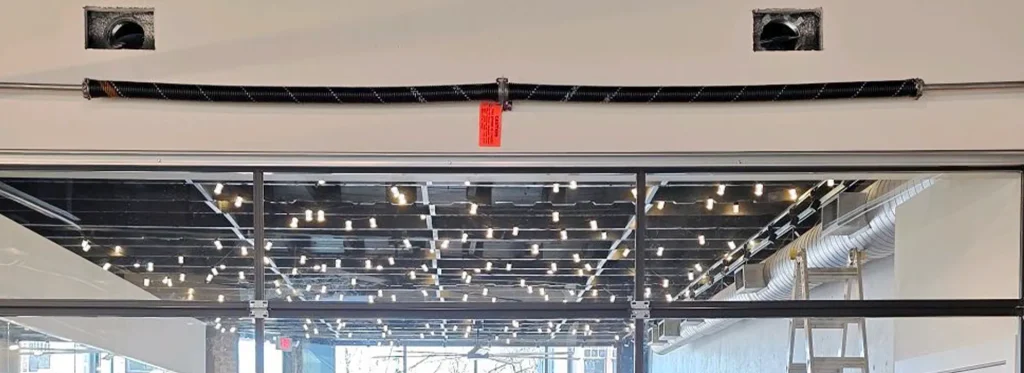
A loud bang followed by a door that suddenly feels extremely heavy is almost always a broken torsion spring. Under ANSI/DASMA 103, which governs counterbalance systems on residential sectional garage doors, springs are the primary load-bearing component. When one fails, the opener and cables absorb weight they were never designed to carry. Stop using the door immediately and call for professional garage door repair.
A popping or snapping sound during operation can signal a cable under increasing stress. What we find on these calls is that the cable issue is often downstream of a spring that has been losing tension for weeks. The opener showed the strain first, then the cable.
When a Stuck Door Becomes a Repair Emergency
A door that is slow or hesitant is different from one that has stopped moving altogether, and the distinction matters for how urgently the situation needs to be addressed.
A door that reverses before fully closing is usually a sensor or limit switch issue. Photo-eye sensors are sensitive to small shifts in alignment. When they drift, the door reads the misaligned beam as an obstruction and reverses. A sensor realignment is typically a quick fix, but the same symptom can result from track obstruction or a failing opener logic board, which is why a technician should confirm the cause.
A door that will not lift, drops on one side, or opens only a few inches before stopping is almost always a spring or cable failure. Using it further risks additional damage and creates a genuine safety hazard.
A telling example is a door found stuck partway open with a vehicle inside. The spring had broken overnight. Instead of calling for service, the opener was run repeatedly trying to force the door up. The result was a bent track and a stripped opener gear. A straightforward repair became significantly more involved because the system kept running after it had already failed.
What the 25-Point Inspection Finds That Homeowners Miss
The gap between what a homeowner sees and what a trained technician finds during a full inspection is often significant.
Our technicians complete a 25-point safety inspection on every call covering every major component regardless of what triggered the visit. Worn rollers show lateral play before producing audible noise. Cables develop small frays before showing visible sag. Springs lose tension gradually before the door starts to feel meaningfully heavier. None of those early warning signs are obvious without specifically looking for them.
A pattern we see consistently is a homeowner who calls about a noise and leaves the inspection with several additional items flagged at varying stages of wear. The noise was the symptom. The inspection showed the full picture. Homeowners who came in describing a squeaky door consistently noted the door felt and sounded noticeably better after service, not just quieter but smoother through the full travel path.
IDA-certified technicians are trained to identify the actual source of a noise rather than the nearest visible component. That is what produces a repair that holds rather than one that leaves the underlying cause to surface again in a few weeks.
Simple Maintenance vs. Professional Repair: Knowing the Line
The line between what a homeowner can safely handle and what requires a professional is not about technical confidence. It is about stored tension in load-bearing components.
Homeowner-safe tasks include applying garage door lubricant to rollers, hinges, springs, and bearing plates twice a year, tightening loose bolts on track brackets, and visually inspecting cables and springs from a safe distance for signs of fraying, rust, or visible gaps in the spring coil.
Professional-only tasks include spring adjustment, cable replacement, track realignment, opener gear repair, and anything involving bottom brackets or winding cones. Bottom brackets connect directly to the cable and spring system under significant tension. A winding cone holds enough stored energy that improper handling causes serious injury.
Transparency about that line is part of every service call at Lonecrest Garage Doors. The goal is to make sure the homeowner understands what needs professional attention and what they can monitor going forward. That honest communication is what turns a service call into a relationship.
Schedule Garage Door Repair With Lonecrest Garage Doors
A noise that started small and stayed small is usually a maintenance issue. One that has changed in character, gotten louder, or returned quickly after lubrication is asking for a closer look. Knowing the difference is exactly what a trained technician can tell a homeowner in the first few minutes of an inspection.
At Lonecrest Garage Doors, every service visit begins with a full system inspection so the actual source of the problem is identified before any work begins. That approach protects the homeowner from a repair that addresses the symptom and leaves the cause.
Lonecrest Garage Doors serves homeowners in Marshall and nearby areas with veteran-owned, IDA-certified service built on honest inspections and dependable workmanship. If your door is making a sound it did not used to make, do not wait for it to get worse. Reach out to Lonecrest Garage Doors today to schedule a full system inspection and find out exactly what your door needs.