
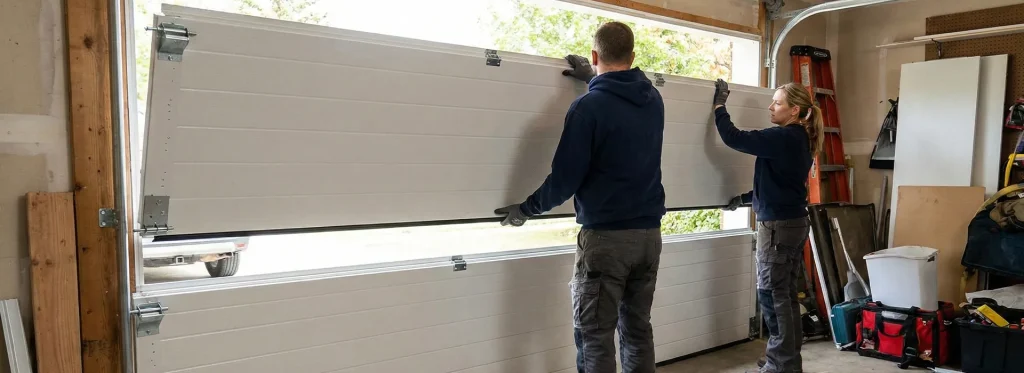
A garage door installation is not simply choosing a door and having it hung. It is a system decision that connects the door panel to the springs, cables, drums, opener, and tracks, and every component needs to match the weight and usage demands of the new door. One of the more instructive consultations involved a first-time homeowner who purchased a house with a builder-grade door well past its useful service life. Before any door selection could happen, the inspection revealed a torsion spring showing corrosion consistent with years of East Texas humidity, a completely deteriorated bottom seal, and an opener running on a logic board no longer supported by the manufacturer. The homeowner had assumed replacing the door meant swapping the panels. The consultation revealed it meant assessing an entire system. For homeowners in Marshall and surrounding areas, this guide covers what first-time owners need to understand before, during, and after a garage door installation.
What a Garage Door System Actually Consists Of
Most first-time homeowners think of a garage door as the panels. The panels are only one part of a system that must work together precisely for the door to operate safely.
The spring system, either torsion springs on a horizontal shaft above the door or extension springs along the tracks on either side, does the work of counterbalancing the door weight. A standard residential door can weigh anywhere from 100 to 400 pounds depending on material and insulation level. The springs handle that load on every cycle.
The cables transfer the spring’s stored energy to the door, running from the bottom brackets up to drums on the torsion bar. The tracks guide the door through its travel path, and their gauge must match the door weight. The opener powers the operation in tandem with the springs. An opener paired with a mismatched spring does far more work than it was designed to do.
ANSI/DASMA 103, the standard governing counterbalance systems on residential sectional garage doors, specifies that spring sizing must correspond precisely to door weight. That requirement exists because of the consequences of a mismatch compound across every component with every cycle.
What to Know About Builder-Grade Doors Before You Replace Them
First-time homeowners who purchase existing homes are almost always inheriting a builder-grade garage door system, and understanding what that means shapes every replacement decision.
Builder-grade doors are installed to minimum specifications at the lowest cost. Standard 10,000-cycle torsion springs sized to the lightest acceptable door weight. Single-layer steel panels with minimal insulation. Openers selected for basic function rather than long-term reliability. Bottom seals that deteriorate faster in East Texas heat and UV exposure than premium alternatives.
For a new homeowner in Marshall, where summer heat accelerates wear and humidity works into spring coils and cable strands year-round, understanding what came with the house is the first step toward a smart replacement.
What we consistently find on pre-installation inspections of older East Texas homes is that builder-grade torsion springs show corrosion and cycle fatigue well before the door panels show visible wear. The panels look acceptable. The spring system tells a different story. A corroded spring on a door being upgraded to a heavier insulated panel is waiting for early failure, because the spring specification was never sized for the new door weight.
Assessing what exists before deciding what to order separates a replacement that delivers years of reliable performance from one that repeats the problems of the original.
The Decisions That Matter Most Before Installation Day
Before a new door can be ordered and installed, several interconnected decisions need to be made as a system rather than in isolation.
Door material and weight is the most consequential decision. The weight of the chosen door determines the spring specification, opener horsepower, and track gauge. A standard single-layer steel door weighs between 100 and 130 pounds. An insulated double-layer door weighs between 150 and 200 pounds. Each weight range requires a different spring specification under ANSI/DASMA 103. Upgrading from a builder-grade single-layer to a double-layer insulated door without recalculating the spring specification creates an under-sprung system from day one.
Insulation level directly affects energy costs and room comfort in Marshall’s climate. Double-layer doors with polystyrene insulation reach R-6 to R-9. Triple-layer polyurethane doors, including Clopay Intellicore and Amarr Thermacore models, reach R-18 and higher. For an attached garage sharing walls with living space, the insulation level directly affects how hard the HVAC system works in summer.
Opener compatibility is the third decision. A half-horsepower opener adequate for a 130-pound single-layer door is under chronic overload when paired with a 200-pound insulated panel. The motor runs hotter and the gears wear faster.
Style and dimensions complete the pre-installation decisions. The door must fit the opening precisely, with correct headroom clearance for the track and opener configuration.
What Happens During a Professional Installation
Understanding what a professional installation involves helps first-time homeowners know what to expect.
The technician begins with a full assessment of the opening, existing hardware, and any components being carried over. Spring specifications are confirmed against the new door weight. Track gauge and mounting hardware are verified. The old door is removed and the new panels assembled.
Springs are wound to the correct torque using hardened steel winding bars in precise quarter-turn increments. The number of turns is calculated based on wire diameter, inside diameter, and door weight. An incorrectly wound spring produces a door that is either too heavy for the opener or wound beyond its safe stress limit.
Cables are attached and wound onto the drums. The opener is mounted, integrated, and programmed. Safety sensors are aligned and tested by placing an object in the door’s path and confirming it reverses on contact.
The door is disconnected from the opener and tested for balance by confirming it holds position at mid-height. A door that holds is correctly sprung. One that drops or rises indicates the spring specification needs adjustment before the job is finished.
IDA-certified technicians are trained to complete every step to the correct standard on every installation. First-time homeowners who stay present often leave with a practical understanding of how the system works, which makes every future service call more productive.
What the Installation Covers and What Comes With It
A complete professional installation covers more than the door itself, and understanding what is included helps first-time homeowners evaluate what they are getting.
The installation covers the door panels, spring system, cable and drum assembly, track installation, opener mounting and programming, safety sensor alignment, and weathersealing. It also protects the manufacturer warranty on both the door and the opener. Most manufacturers require professional installation for their warranty to remain valid. A self-installed door that develops a spring failure or panel defect within the first year may not be covered if the installation was not performed by a qualified technician.
At Lonecrest Garage Doors, homeowners who choose a full rebuild are covered by the 10-year rebuild warranty on rollers, cables, drums, bearings, and springs. Brands installed include Amarr, CHI, Clopay, Doorlink, Genie, Haas Door, and LiftMaster.
First-time homeowners who understand what the installation covers are better equipped to compare quotes and recognize when a lower-priced option is leaving out components that will cost more later.
Maintaining Your New Garage Door After Installation
A new garage door is a long-term investment, and a basic maintenance routine protects that investment between professional service visits.
Lubrication is the most important homeowner task. Apply a dedicated garage door lubricant to rollers, hinges, springs, and bearing plates twice a year. Standard household grease attracts dirt and causes buildup that shortens component life. A dedicated lubricant reduces friction without that problem.
Visual inspection every few months catches issues early. Check cables for fraying along the strand surface. Look at spring coils for rust or corrosion, particularly after a wet season. Check hardware bolts on track brackets for looseness.
The balance test is the most useful homeowner diagnostic. Disconnect the opener and lift the door manually to mid-height. A properly balanced door holds its position. One that drops or rises indicates spring tension has shifted and a technician should evaluate it.
Inspect the bottom seal annually and replace it when it shows cracking or gaps. In East Texas, summer heat and UV exposure accelerate rubber deterioration, and a failed bottom seal undermines the insulation performance of even the highest R-value door.
First-time homeowners who follow this routine consistently extend the time between service calls. The 25-point safety inspection our technicians complete on every visit is the professional counterpart, covering components that require a trained eye to assess accurately.
Schedule Garage Door Installation With Lonecrest Garage Doors
A first garage door installation sets the baseline for how the system performs and how long every component lasts. Getting the spring specification, opener matching, and insulation level right from the start prevents the early repair cycle that builder-grade installations often produce.
At Lonecrest Garage Doors, every installation begins with a full system assessment before any product is ordered. Brands installed include Amarr, CHI, Clopay, Doorlink, Genie, Haas Door, and LiftMaster. Lonecrest Garage Doors serves homeowners in Marshall and nearby areas with veteran-owned, IDA-certified service built on honest assessments and dependable workmanship. Reach out to Lonecrest Garage Doors today to schedule an installation consultation and start with a system correctly matched from day one.