
One of the more telling moments on a spring repair call is finding a door stuck halfway open at an angle, with the car still inside. The homeowner forced it after the spring snapped overnight, and what started as a broken spring became a bent track, a stripped opener gear, and a door that could no longer be safely moved in either direction. Garage door spring repair is one of the most physically hazardous repairs in residential home service, and for homeowners in Marshall and surrounding areas, the risk is not always obvious until something goes wrong. This piece walks through why springs carry such significant danger, what the warning signs look like before a failure, and why this is a repair that should always be handled by a trained technician.
Why Garage Door Springs Are Under More Tension Than Most Homeowners Realize
Most homeowners think of a garage door spring as a simple supporting component. A standard residential torsion spring is wound to a precise torque, measured in inch-pounds, that corresponds exactly to the weight of the door it is designed to lift. A typical residential garage door weighs anywhere from 150 to 400 pounds depending on the material, size, and insulation level. The spring carries that load every single time the door moves.
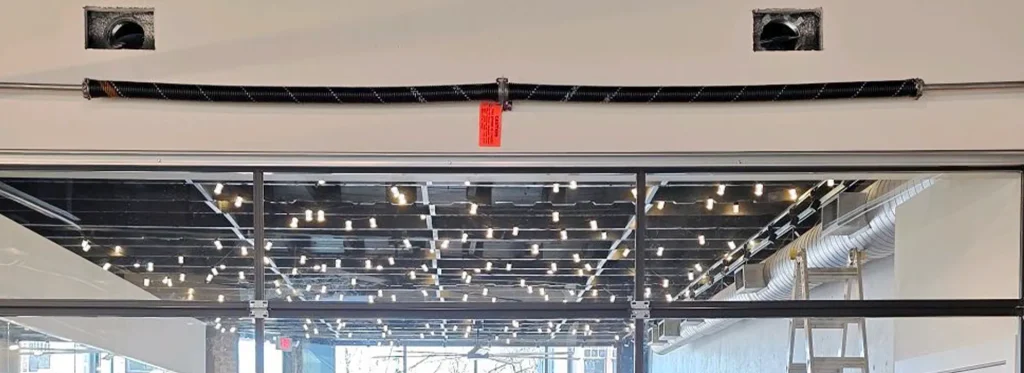
Torsion springs sit horizontally on a steel shaft above the door. When the door closes, the spring winds tighter, storing mechanical energy. When the door opens, it unwinds and releases that energy to lift the panel. Extension springs stretch along the tracks on either side of the door and operate on the same principle: stored tension counterbalancing a heavy door.
That stored energy does not disappear when the spring breaks. It releases instantly, in the wrong direction, with no warning.
A torsion spring under full load that snaps mid-cycle does not simply fall. The coil can whip across the shaft with enough force to cause serious injury. In our experience, calls involving the most additional damage are ones where the door kept operating after the spring had already started to fail.
The Real Risks of a Failing or Broken Spring
A spring that is worn, corroded, or approaching the end of its cycle life does not always announce itself with a loud snap. Sometimes the warning signs are gradual, and the door keeps working, just barely, until it does not.
What changes when a spring begins to fail is the load distribution across the rest of the system. The opener starts doing work it was never built for. Cables pull unevenly. Drums on one side experience more tension than the other. The door moves in a way that is slightly off, not enough to stop daily use, but enough to create compounding stress on every connected component.
When a torsion spring finally breaks, the door typically drops on one side or falls completely, depending on the configuration. We have seen doors come off their tracks entirely after a spring failure because the sudden imbalance pulled the rollers free.
A door operating on a failing spring can drop without warning at any point, and the people underneath it have no way of knowing the counterbalance is no longer reliable.
Why DIY Spring Repair Is Dangerous Even for Handy Homeowners
Garage door spring repair is not a task that becomes safe with the right attitude or tools from the hardware store. Hardened steel winding bars rated for the correct diameter are not standard residential toolbox items, and using substitutes is where most DIY injuries happen.
Winding a torsion spring requires inserting a winding bar into the winding cone and applying controlled force in precise quarter-turn increments. The number of turns depends on wire diameter, inside diameter, and door weight. An incorrect wind, even by a quarter turn, produces a door that is either too heavy for the opener or wound beyond safe stress limits.
Releasing tension without controlling the shaft is where serious accidents happen. A winding bar that slips becomes a projectile. The shaft itself can spin unexpectedly. These are not hypothetical risks. They are the reason ANSI/DASMA 103, the standard governing counterbalance systems on residential sectional garage doors, exists. Our technicians hold IDA certification and are trained to work within those standards on every call.
The stored energy in a loaded spring does not change based on how comfortable someone is with home repair.
Signs Your Garage Door Springs Are a Safety Risk Right Now
Recognizing the warning signs of a failing spring does not require getting close to the hardware. Most of the indicators are visible or noticeable from normal operating distance, which is exactly where a homeowner should stay when something seems off.
A loud bang from inside the garage, often described as sounding like a gunshot, is the clearest sign that a spring has already snapped. If you hear that sound, stop using the door immediately.
A visible gap in the torsion spring above the door is a confirmed break. A gap of an inch or more in the coil means the spring has separated under tension.
A door that feels significantly heavier than usual when lifted manually is another indicator. As springs lose tension over their cycle life, they support less of the door weight, and that shift is noticeable when you try to lift the door by hand.
Uneven movement, where one side rises faster than the other, points to a spring system that is no longer balanced. Surface rust on the coils after a wet East Texas season can accelerate wear to the point where a spring that looks intact is near failure. DASMA’s technical guidance on spring cycle life identifies corrosive environments and extreme heat as factors that shorten spring lifespan, both relevant to East Texas conditions.
What we consistently find is that homeowners calling for an opener issue are often dealing with a spring that has been quietly failing for weeks. The opener shows the symptoms, but the spring is the source.
What a Professional Garage Door Spring Repair Actually Involves
When a trained technician arrives for a spring repair, the first step is a full assessment of the door system, not just the broken component. A spring does not fail in isolation. Cables, drums, bearings, and door balance all need to be evaluated before the replacement spring goes in.
The technician measures the door weight and identifies the correct spring specs: wire diameter, inside diameter, length, and wind direction. Incorrect specs produce a door that is unbalanced from day one.
The old spring is safely unwound using proper winding bars and controlled technique before it is removed. The replacement spring is installed on the shaft, wound to the correct torque in quarter-turn increments, and tested against the actual door weight. The door is then checked for balance by disconnecting the opener and confirming it holds position at mid-height on its own.
At Lonecrest Garage Doors, every spring repair includes a full inspection of surrounding components. We check cables for fraying, examine drums for wear, and review the overall condition of the door before finishing the call. Homeowners who choose a full rebuild are covered by a 10-year rebuild warranty on rollers, cables, drums, bearings, and springs.
How Regular Inspections Prevent Spring-Related Safety Issues
The most effective way to avoid a dangerous spring failure is to catch the wear before the break happens. That requires a trained eye, because the signs of a spring nearing the end of its cycle life are easy to miss without knowing what to look for.
During a routine service visit, our technicians check springs as part of a 25-point safety inspection. Spring tension is evaluated, coils are examined for rust and fatigue, and door balance is tested to catch uneven wear before it becomes a hazard.
A pattern we see regularly is a call placed for a noisy door or a struggling opener where, upon inspection, the spring is the root cause. The opener was compensating because the spring had quietly lost tension. The homeowner had no idea because the door was still technically opening each day.
Catching that wear early means scheduling replacement before a failure occurs, not after.
Schedule Garage Door Spring Repair With Lonecrest Garage Doors
Garage door spring repair carries real risk that does not shrink with confidence or experience. The tension involved, the precision required, and the potential for sudden failure make this one of the few residential repairs where professional service is not just recommended but necessary.
Lonecrest Garage Doors serves homeowners in Marshall and nearby areas with veteran-owned, IDA-certified service built on honest inspections and solid workmanship. If your door is showing any signs covered in this guide, do not wait for the spring to fail. Our team has seen firsthand what a delayed repair costs a homeowner in safety and additional damage. Reach out to Lonecrest Garage Doors today to schedule a full system inspection and spring repair from a team that puts the safety of your home and family first.